01 Starting point
Trading vehicles between dealers follows different rules than selling to consumers. Terms are not public, prices are negotiated net of VAT, and the circle of buyers is deliberately small. An open shop would be the wrong tool here: it would put trade prices in front of consumers and competitors.
Then there is the nature of the goods. A vehicle is not a catalogue item with a stock level. It is a one-off with a chassis number, mileage, first registration date, a list of options and a very short window in which it is available. Standard shop systems assume products you can reorder. Modelling one-off items at this depth of detail is where the real work sits in projects of this kind.
02 Solution
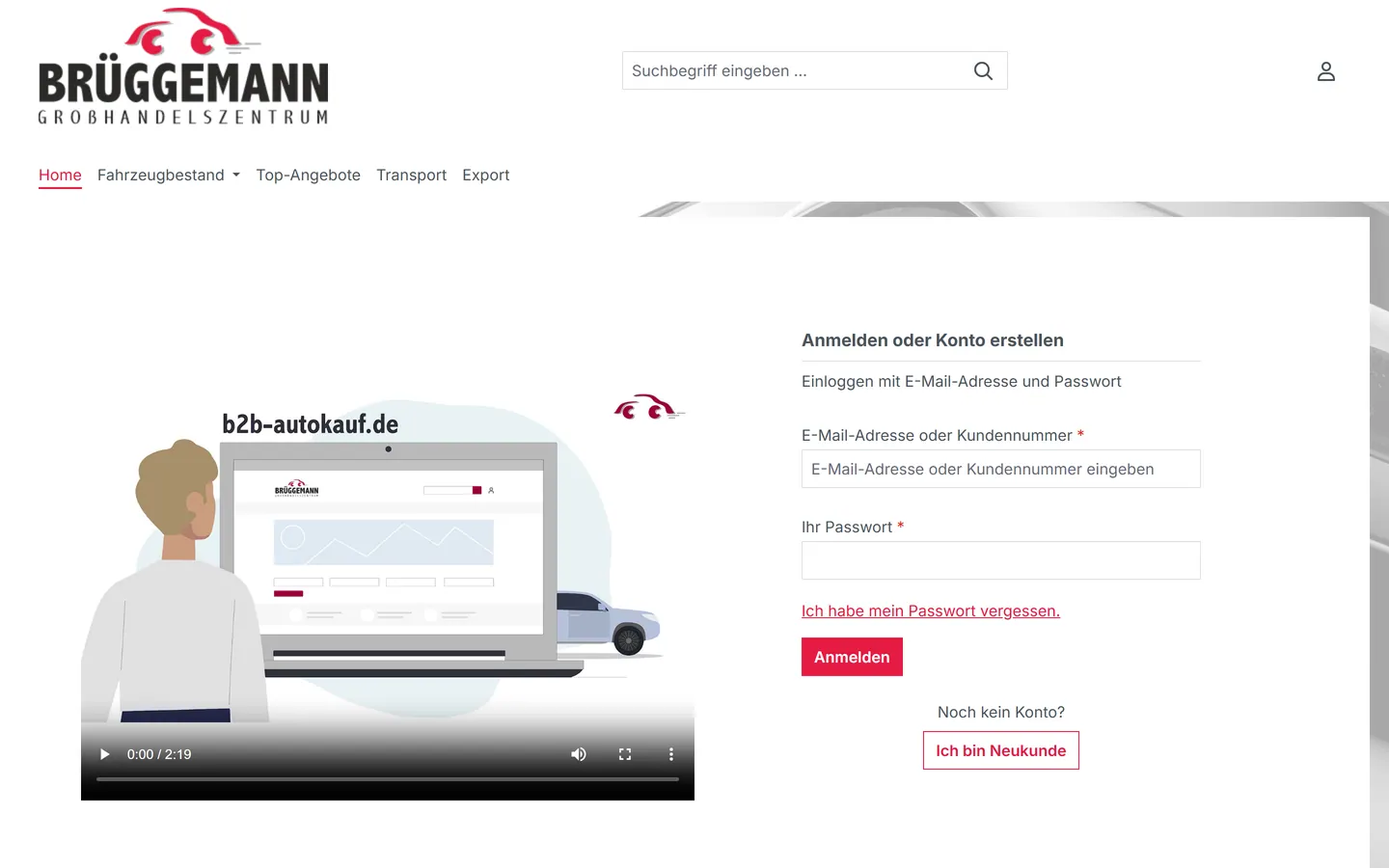
The marketplace is built on Shopware 6. The shop is fully closed: without a login, no vehicle and no price is visible. New applicants go through a registration route that records company data and proof of dealer status. Accounts are not activated automatically; each one is checked first. Only then does the customer group take effect, and with it visibility, price display and payment methods.
Vehicles are modelled as individual items. Chassis number, first registration, mileage, gearbox, drivetrain, colour and equipment are held as structured properties rather than as running text, and search and filters work off them. Prices are shown net of VAT, and the display allows for the usual cases in the trade, such as margin-scheme taxation. Sold or reserved vehicles are taken out of the listing instead of lingering as leftovers.
Stock data reaches the shop through an interface. Each run creates new vehicles, updates existing ones and deactivates listings that have run out. The shop therefore stays on the same data source as the other sales channels. We run, update and monitor the Shopware installation on our own servers in Germany.
03 Result
Dealer-to-dealer trade runs through one controlled channel instead of lists, PDFs and email distribution. Anyone with access sees the current stock with the details a trade buying decision needs. Anyone without access sees nothing.
Because stock keeping and shop hang on the same data source, the B2B channel needs no separate maintenance. New vehicles are available without extra work, and the approval step remains the only point where someone deliberately decides by hand.