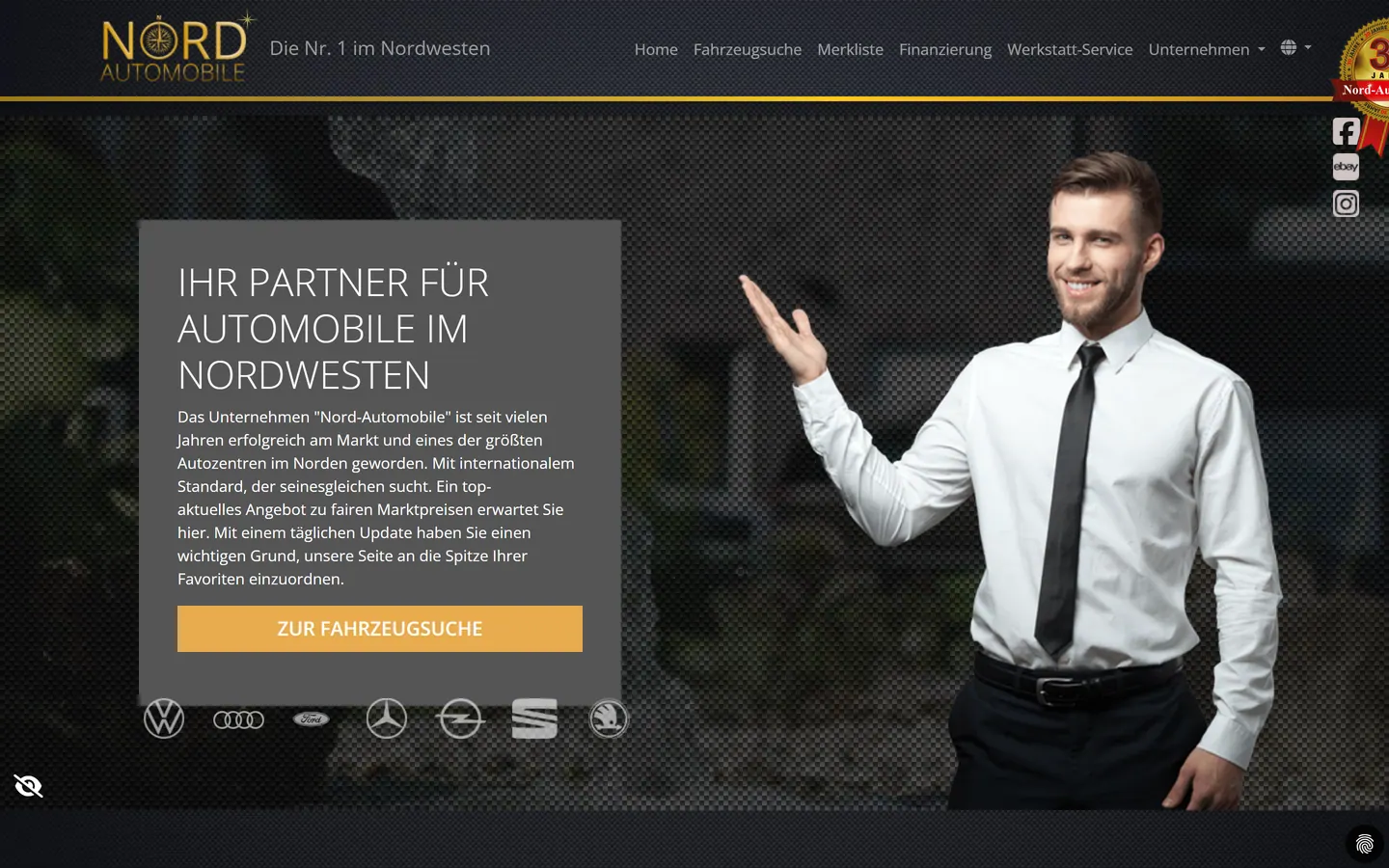
01 Starting point
Nord Automobile in Rastede runs a four-digit inventory and updates it daily. At that size it is no longer the design that decides whether someone finds a vehicle — it is the search. Anyone offering seven filters has to make them usable.
This is exactly where many vehicle searches fail: every change to a filter reloads the entire page. The visitor loses their scroll position, waits, loses the thread — and gives up, usually on a mobile device, where the rebuild costs most. It is a usability problem, not a design problem.
02 Solution
The site is built on TYPO3. The vehicle search runs as a dedicated extension with its own AJAX endpoint: price range, brand, model, first registration, mileage and sort order are evaluated on the server, but only the result list is reloaded. The page stays put and the result count updates with it. Filtering feels like an application rather than a form.
The site is bilingual by design. TYPO3 keeps translations separate from structure, so vehicle data flows from one source into both language versions — technical details such as first registration, mileage and engine output are language-neutral anyway and need no second round of upkeep.
Around the trade sit the areas that make up a dealership: workshop service, financing and used-car warranty, plus team, careers, awards and events. These are maintained through defined content elements rather than freely pasted HTML — which is what keeps the layout consistent after years of editing. It runs on PHP 8 with MariaDB and caching on our own servers in Germany, with maintenance and development in the same hands.
03 Result
The inventory is shown as it stands today, and the search stays quick to operate even with more than a thousand vehicles — on a phone as much as at a desk. New vehicles go live from the backend; sold ones disappear without leaving traces in lists or search results.
The foundation can be extended. Additional vehicle fields, further filter criteria or a later connection to an internal inventory system are data-model and configuration work, not a rebuild of the site.